Monday, December 28, 2015
No Home For The Holidays
The holiday season is truly a magical time of year. It is a time for giving, reflection, and appreciation. Many individuals and organizations come together and show thanks by donating what they can to those in need. Unfortunately, the holidays will not be magical for everyone, especially not for a high proportion of lesbian, gay, bisexual, transgender, queer, and 2-Spirit (LGBTQ2S) youth who have experienced familial, societal, and institutional rejection. In fact, the holidays can be an especially lonely time for many, particularly for those without a safe place to call home.
Every single day in drop-in services and housing programs across Canada, LGBTQ2S youth face discrimination, rejection, and violence based on their gender and sexual identities. This is not a new problem. We have known about this issue for a long time.
Approximately 23 years ago, a study conducted in Toronto provided evidence revealing for the first time that lesbian, gay, and bisexual youth experienced discrimination in Toronto's shelter system. Although there has since been minimal research conducted in the area of LGBTQ2S youth homelessness in Canada, over the years we have heard from young people themselves about their experiences in support services and housing programs, exposing the harsh reality that these youth often face. Enough data have been collected to support a much-needed change in service delivery.
2015 was an important year for LGBTQ2S communities across the globe. We have certainly seen a substantial shift with regards to how this issue is dealt with and addressed nationally, and internationally alike. Key decision makers are finally including LGBTQ2S youth homelessness on their agendas and there is momentum. It is also safe to say that on some level there is an understanding that this is an emergency situation.
Here in Canada, local and national organizations have started responding by creating awareness raising campaigns and initiatives. A Housing First program for LGBTQ2S youth opened in Vancouver; and in Calgary, Canada's first LGBTQ2S Host Homes program was launched.
The Alberta government has set an excellent example by prioritizing LGBTQ2S youth and supporting the development of a strategy that will help meet the needs of this population of young people in Alberta and ensure that they are served more appropriately. Earlier this year, Toronto City Council approved funding for two LGBTQ2S transitional housing programs. Canada's first LGBTQ2S transitional housing program as intended to open summer 2015, but we are still waiting for the program to launch.
Research has continuously supported the creation of LGBTQ2S specific housing options, which is something that has been hugely successful in the United States. However, there are no current plans to open any specialized LGBTQ2S emergency shelters, a necessary service for young people in emergency situations.
Similar to the situation over two decades ago, queer and trans youth are still overrepresented in the homeless youth population, with estimates as high as up to 40 per cent of homeless youth identifying as LGBTQ2S. Housing programs and drop-in services remain unsafe in many circumstances, due to homophobic and transphobic violence and discrimination. LGBTQ2S youth also face increased risk of physical and sexual exploitation, mental health difficulties, substance use, and high rates of suicide.
When we do not respond and when we do not take action, we are inadvertently telling society that these youth do not matter, and it is okay to discriminate against them and to keep them waiting for a safe place to sleep.
A promise means nothing unless there is follow through.
I recently asked a young trans man what it is like to be a trans youth experiencing homelessness in Toronto. Here is what he said:
"I have no place I feel safe. There's nowhere to go, and I thought there would be because this is Toronto, if the rest of Ontario has nowhere for me to go I thought Toronto would at least have somewhere, but they don't and I have been all over the place, I have been everywhere in this area. There's nowhere to go.
Try living in a world where it's hard enough to love yourself, but even harder to be accepted, going into a place where you think you can be safe, going into a place where you assume you can get help but every door you try to open is locked or sealed shut, you're trying to walk back to where you started but that door is also locked. You try very hard to break down that door. Once you get through you realize you cannot be you, that's what it's like." (Atlas)
I cannot comprehend that as we enter 2016, we are still not providing basic necessary services to LGBTQ2S youth in one of the richest countries in the world.
During this holiday season young people will still be waiting for a safe place to sleep. With the cold Canadian winter quickly approaching, the wait can be life threatening.
What are we waiting for?
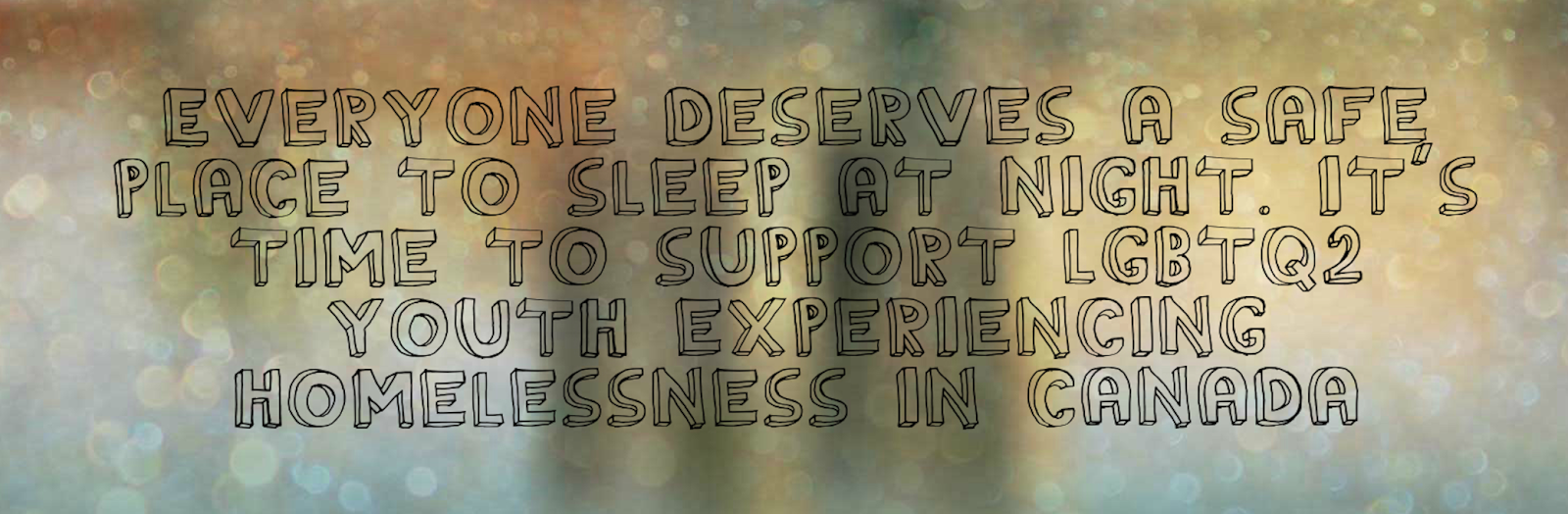
Everyone deserves a safe place to sleep.
(See Huffington Post for original posting)
Monday, December 22, 2014
Not just during the holidays, but all year round.
I like to take some time at the end of each year to reflect on the year gone by, which is why I usually write an end of year blog post.
At the end of 2013, we were left with the hope that 2014 would bring new and improved strategies and solutions to how Toronto deals with: homophobic and transphobic violence in shelters, the overrepresentation of LGBTQ2 youth in the homeless youth population, and the barriers to accessing shelters and support services experienced by LGBTQ2 youth.
We ended the year with this wonderful article written by Andrea Houston.
2014 was a big year - it was the year that LGBTQ2 youth homelessness finally became part of important dialogue concerning youth homelessness in Canada. There were many significant moments, meetings, conferences, and events that took place over the course of the year, so I’ve decided to feature some of the highlights in this post.
The City of Toronto not only acknowledged that LGBTQ2 youth homelessness is a major problem, but also supported the formation of two working groups devoted to: 1. Updating the Toronto shelter standards through a LGBTQ2 lens. 2. Assisting the City in addressing the needs of LGBTQ2 youth experiencing homelessness. The City of Toronto also reported back positively, regarding the feasibility of creating specialized housing for LGBTQ2 youth; which makes me feel quite optimistic about what 2015 will bring.
In March, I completed my PhD - "Young, Queer and Trans, Homeless, and Besieged: A Critical Action Research Study of How Policy and Culture Create Oppressive Conditions for LGBTQ Youth in Toronto's Shelter System".
My Doctoral research was truly a significant research journey for me and is part of a large body of work that I call my “life work”. The stories that the young people who participated in the study shared with me were beautiful, tragic, sad, enriching, and heartbreaking all at once. I continue to hold these painful and tragic stories close to my heart and transform them into energy that will help me advocate for a safe, accessible, supportive, and affirming shelter system for all LGBTQ2 young people across the country.
This study has demonstrated the dire need for the creation of specialized services and safe spaces for LGBTQ2 youth experiencing homelessness, for stricter policies against homophobia and transphobia in the shelter system, and for more discussions of inclusion and acceptance among shelter providers and workers.
Interest in the issue of queer and trans youth homelessness increased significantly in 2014. Shelters across Toronto reached out for assistance in updating old policies and developing new ones, staff training, and raising awareness about queer and trans youth homelessness. The media also paid close attention, which of course helped bring this issue to the forefront of many important discussions:
NOW Magazine
Metro Morning, CBC
In June, Toronto hosted World Pride and for the World Pride Human Rights Conference, we brought together an international panel (Dwayne’s House, Jamaica; True Colors Fund, New York City; Ruth Ellis Center, Michigan) on LGBTQ2 youth homelessness for a discussion of global responses to LGBTQ2 youth homelessness.
This received more great coverage by NOW Magazine.
Days before the official launch of World Pride, Teal and I deputed at the CDR Committee meeting at City Hall, asking for mandatory LGBTQ2 cultural competency training for all shelter staff and for policies that would help make the shelter system safe, accessible, and supportive of LGBTQ2 youth. This momentous meeting marked an important day for the City of Toronto, a moment that I had waited a long time for.
It was great to see the Toronto Star cover this significant step forward.
I was also extremely grateful to have been selected as an "Honoured Trans Individual" to lead the World Pride Trans March. After many years of advocacy and trying to raise awareness to the issue of LGBTQ2 youth homelessness, it gave me much happiness to see that Pride Toronto recognized that the work to end queer and trans youth homelessness deserved to be highlighted. It was also brilliant to see so many people come together to hold up signs at the Trans March and help bring the issue of LGBTQ2 youth homelessness to Pride.
More recently, I was invited to give a keynote presentation at the Wood’s Homes 2nd provincial Youth Homelessness Symposium: “The Unspoken: Thoughts and Reality – LGBTQ2 Youth Homelessness” in Calgary, Alberta. The symposium was well attended, with close to 100 people from youth services across the province of Alberta. The symposium was meant to share knowledge and expertise in addressing the multiple complex layers of youth homelessness.
The youth homelessness symposium received some great media coverage: Global Calgary
CBC Calgary
CBC Homestretch
The Government of Alberta has recognized that ending youth homelessness will require targeted responses for specific subpopulations, which will include critical attention on meeting the needs of LGBTQ2 youth. I am currently working with Alberta Human Services and stakeholders across Alberta on the development of strategies that can be implemented into all youth serving organizations and shelters across the province of Alberta. It is my hope that other provinces across the country will follow Alberta’s lead and begin prioritizing this population of young people.
Over the past year, we have seen a huge shift regarding this issue and people’s willingness to discuss and address these problems.
People are finally having discussions.
People are starting to pay attention and understand that this is an emergency situation across Canada.
Organizations are coming forward and creating specialized initiatives and programs for queer and trans youth experiencing homelessness.
However, LGBTQ2 youth are still overrepresented in the homeless youth population, and still there is minimal support available, and many support services across the country are unsafe for queer and trans youth due to homophobic and transphobic violence.
It is always amazing to see so many individuals and organizations come together around the holidays to volunteer and help people experiencing homelessness.
It is truly a wonderful thing.
I hope that the desire to help does not end on January 1, because everybody deserves a safe place to sleep at night, not just during the holidays, but all year round.
Everybody deserves a safe place to sleep at night.
As we begin another year and move forward with this important work, it is my hope that we will change the way that we approach this issue.
It is my hope that we will fight even harder to end LGBTQ2 youth homelessness across Canada.
At the end of 2013, we were left with the hope that 2014 would bring new and improved strategies and solutions to how Toronto deals with: homophobic and transphobic violence in shelters, the overrepresentation of LGBTQ2 youth in the homeless youth population, and the barriers to accessing shelters and support services experienced by LGBTQ2 youth.
We ended the year with this wonderful article written by Andrea Houston.
2014 was a big year - it was the year that LGBTQ2 youth homelessness finally became part of important dialogue concerning youth homelessness in Canada. There were many significant moments, meetings, conferences, and events that took place over the course of the year, so I’ve decided to feature some of the highlights in this post.
The City of Toronto not only acknowledged that LGBTQ2 youth homelessness is a major problem, but also supported the formation of two working groups devoted to: 1. Updating the Toronto shelter standards through a LGBTQ2 lens. 2. Assisting the City in addressing the needs of LGBTQ2 youth experiencing homelessness. The City of Toronto also reported back positively, regarding the feasibility of creating specialized housing for LGBTQ2 youth; which makes me feel quite optimistic about what 2015 will bring.
In March, I completed my PhD - "Young, Queer and Trans, Homeless, and Besieged: A Critical Action Research Study of How Policy and Culture Create Oppressive Conditions for LGBTQ Youth in Toronto's Shelter System".
My Doctoral research was truly a significant research journey for me and is part of a large body of work that I call my “life work”. The stories that the young people who participated in the study shared with me were beautiful, tragic, sad, enriching, and heartbreaking all at once. I continue to hold these painful and tragic stories close to my heart and transform them into energy that will help me advocate for a safe, accessible, supportive, and affirming shelter system for all LGBTQ2 young people across the country.
This study has demonstrated the dire need for the creation of specialized services and safe spaces for LGBTQ2 youth experiencing homelessness, for stricter policies against homophobia and transphobia in the shelter system, and for more discussions of inclusion and acceptance among shelter providers and workers.
Interest in the issue of queer and trans youth homelessness increased significantly in 2014. Shelters across Toronto reached out for assistance in updating old policies and developing new ones, staff training, and raising awareness about queer and trans youth homelessness. The media also paid close attention, which of course helped bring this issue to the forefront of many important discussions:
NOW Magazine
Metro Morning, CBC
In June, Toronto hosted World Pride and for the World Pride Human Rights Conference, we brought together an international panel (Dwayne’s House, Jamaica; True Colors Fund, New York City; Ruth Ellis Center, Michigan) on LGBTQ2 youth homelessness for a discussion of global responses to LGBTQ2 youth homelessness.
This received more great coverage by NOW Magazine.
Days before the official launch of World Pride, Teal and I deputed at the CDR Committee meeting at City Hall, asking for mandatory LGBTQ2 cultural competency training for all shelter staff and for policies that would help make the shelter system safe, accessible, and supportive of LGBTQ2 youth. This momentous meeting marked an important day for the City of Toronto, a moment that I had waited a long time for.
It was great to see the Toronto Star cover this significant step forward.
I was also extremely grateful to have been selected as an "Honoured Trans Individual" to lead the World Pride Trans March. After many years of advocacy and trying to raise awareness to the issue of LGBTQ2 youth homelessness, it gave me much happiness to see that Pride Toronto recognized that the work to end queer and trans youth homelessness deserved to be highlighted. It was also brilliant to see so many people come together to hold up signs at the Trans March and help bring the issue of LGBTQ2 youth homelessness to Pride.
More recently, I was invited to give a keynote presentation at the Wood’s Homes 2nd provincial Youth Homelessness Symposium: “The Unspoken: Thoughts and Reality – LGBTQ2 Youth Homelessness” in Calgary, Alberta. The symposium was well attended, with close to 100 people from youth services across the province of Alberta. The symposium was meant to share knowledge and expertise in addressing the multiple complex layers of youth homelessness.
The youth homelessness symposium received some great media coverage: Global Calgary
CBC Calgary
CBC Homestretch
The Government of Alberta has recognized that ending youth homelessness will require targeted responses for specific subpopulations, which will include critical attention on meeting the needs of LGBTQ2 youth. I am currently working with Alberta Human Services and stakeholders across Alberta on the development of strategies that can be implemented into all youth serving organizations and shelters across the province of Alberta. It is my hope that other provinces across the country will follow Alberta’s lead and begin prioritizing this population of young people.
Over the past year, we have seen a huge shift regarding this issue and people’s willingness to discuss and address these problems.
People are finally having discussions.
People are starting to pay attention and understand that this is an emergency situation across Canada.
Organizations are coming forward and creating specialized initiatives and programs for queer and trans youth experiencing homelessness.
However, LGBTQ2 youth are still overrepresented in the homeless youth population, and still there is minimal support available, and many support services across the country are unsafe for queer and trans youth due to homophobic and transphobic violence.
It is always amazing to see so many individuals and organizations come together around the holidays to volunteer and help people experiencing homelessness.
It is truly a wonderful thing.
I hope that the desire to help does not end on January 1, because everybody deserves a safe place to sleep at night, not just during the holidays, but all year round.
Everybody deserves a safe place to sleep at night.
As we begin another year and move forward with this important work, it is my hope that we will change the way that we approach this issue.
It is my hope that we will fight even harder to end LGBTQ2 youth homelessness across Canada.
Friday, November 21, 2014
LGBTQ2S Youth Homelessness Initiative
Here is a short video introduction to a new and exciting project I am working on that will focus on long-term solutions to LGBTQ2S youth homelessness in Canada.
Stay tuned for more information and to find out how you can get involved!
Thursday, November 20, 2014
Transgender Day of Remembrance 2014 #TDOR
Transgender Day of Remembrance (TDOR) held annually on November 20, is a day that is meant to memorialize transgender people who were killed or have died due to anti-transgender hatred and violence. It also raises public awareness of the violent reality that so many trans and gender non-conforming people face on a daily basis.
Every year, new names are added to the memorial list of trans people who have been killed due to transphobia. This year, on November 20, 2014 at 3pm, the City of Toronto will recognize TDOR for the first time by raising the trans flag at Toronto City Hall.
Transphobia destroys people’s lives.
It is dangerous, toxic, violent, and leads to suicide.
Transphobia kills, period.
Discrimination and violence against transgender individuals is rampant.
Trans people face disproportionately high rates of victimization, unemployment, health inequities, and suicidality. Trans people of colour, especially trans women of colour face the highest rates of violence and discrimination.
The Trans PULSE project, a large Canadian study that investigated health and trans people in Ontario, found that 77% of trans people had seriously considered suicide, and that 45% had attempted suicide. Trans youth were found to be at the greatest risk of suicidality. The high rates of suicide are extremely alarming, especially during the early stages of gender transition, which is when trans people are at greatest risk of suicide. The early stages of transition are also when young people are often kicked out of the house or forced to leave home.
Coming out is hard for everyone. Sometimes there is no way of knowing how transphobic or homophobic your family and friends will be. Sometimes we are unpleasantly surprised. This is the kind of hate that starts in the home and ends on the streets. This is the kind of hate that leads young people into institutions that are ruled by homophobic and transphobic policies.
Lesbian, gay, bisexual, transsexual, transgender, queer, questioning, and 2-Spirit (LGBTQ2S) youth are overrepresented in the homeless youth population: 25-40% of homeless youth identify as LGBTQ2S. Although there are disproportionately high rates of LGBTQ2S youth experiencing homelessness, there is minimal support available, and support services and shelters often further marginalize this population of young people.
Trans and gender non-conforming youth are frequently rejected by shelters based on their gender identity and are regularly not permitted to access the shelter that matches the gender with which they identify because shelters frequently do not feel equipped to support trans youth. This forces trans youth to stay in a shelter that is not consistent with their gender identity, or to avoid the shelter system altogether.
Regardless of shelter standards and shelter policies, frontline workers struggle most with issues regarding access to services and support for trans people, and shelter staff tend to receive minimal training regarding trans-related issues, needs, and terminology. Staff often do not have an understanding of the importance of asking youth what pronoun and name they prefer, or that trans people can also identify as heterosexual and do not always fit under the umbrella term “queer”.
There is a type of normalization of trans oppression that occurs in the shelter system. Even though major emphasis is placed on access and the ability to access shelters with as few barriers as possible, regardless of people’s gender and sexual identities, it has somehow come to be accepted that not all shelters can accommodate trans and gender non-conforming individuals.
Shelters are often segregated by female and male floors, which have female and male bathrooms and showers. The floor that a person will be placed on has more to do with the staff’s perception of a person’s sex and less to do with how an individual actually identifies, which is highly problematic because not all individuals’ gender identity is congruent with the sex assigned to them at birth. For example, if someone presents as more gender ambiguous, then whatever the staff member perceives their sex to be, is what floor they will be placed on. This increases the risk for gender discrimination and gender violence to occur within shelters. It also creates significant barriers to access for genderqueer and gender non-conforming individuals, and individuals who are in the early stages of their transition.
The need for transgender youth to have access to health care professionals who have a comprehensive understanding of trans-related issues and transition-related health care is crucial. The health care needs of trans youth differ from those of lesbian, gay, and bisexual youth, whether they are experiencing homelessness or not. For example, trans youth may need transition related health care, including access to hormones or surgery, or help getting ID and legal name change sorted out. The lack of specialized health care services for trans youth often results in youth turning to unmonitored street suppliers for transition-related treatment, which can have severe health complications. The complexity of these needs intensifies when one is homeless and does not have money, a health card, or a support network.
Being a young person is scary, regardless of your sexual or gender identity. Being a young person who deviates from the norm is terrifying because our culture pathologizes almost every feeling and behaviour that human beings are capable of expressing. The extreme pathologization of gender makes it even more difficult for people to bring their full authentic selves to programs and support services, and to come out as transgender.
Nobody should have to know what it feels like for not having a home simply for being yourself in a world that forces us to be like everybody else, every single day.
Solutions to these issues include practice and policy changes, but first and foremost, people must be respected and treated in their self-identified gender. For example, if someone says that they identify as male, then address them with male pronouns. If someone says that they identify as female, then address them with female pronouns. If someone says that they identify as genderqueer and prefer gender-neutral pronouns, such as they, then address them using they.
Shelters and support services need to be equipped with gender-neutral washrooms. Single occupancy washrooms can be easily converted into a gender-neutral washroom by replacing the female and male silhouette signs with an all gender inclusive sign.
Taking the time to listen to trans youths’ perspectives and needs will help service providers create services that are safe, accessible, and supportive of trans and gender non-conforming youth.
On this day, the Transgender Day of Remembrance, take the time to honour the lives of those who have been killed as a result of anti-trans violence and hatred. Do your part to help end transphobia, not only on November 20, but every day.
Transphobia is an everyday reality for too many individuals.
Transphobia destroys people’s lives.
It is dangerous, toxic, violent, and leads to suicide.
Transphobia kills, period.
Monday, November 17, 2014
Community
There’s something that I need to get off of my chest.
I am profoundly disturbed by the infighting that occurs in the LGBTQ community.
I have been both witnessing and subjected to a type of division that occurs in response to competition, jealousy, and malicious behavior. Rather than working together, and building partnerships and collaborations, people tear one another apart. People are quick to judge and don’t take the time to ask questions and learn about where we have come from or what paths we have traveled.
I worry about the implications that this type of infighting has on the future of our community.
The repercussions of these hateful relations are ugly and dangerous.
This type of hate, ultimately, divides our community and breaks us apart.
It makes us forget what we were fighting for in the first place, and that many of us are fighting for the same causes, for the same rights; many of us are fighting the same fight. Instead we end up fighting against one another, when we could be fabricating a framework that will nurture our diverse and powerful community.
I love being part of the queer community. I love the interesting and dynamic people and relationships that I have been fortunate to build over the years. I am extremely passionate about the work that I do and I will always fight for and stand up for our youth. But this hateful infighting that so frequently occurs, it wears me down and takes my breath away.
Let’s stop with the hate. Let’s be nicer to each other.
Let’s take the time to reflect and ask each other meaningful questions.
Give credit where credit is due.
Rather than competing, try collaborating.
Let's try.
Sunday, October 19, 2014
Meeting the needs of LGBTQ2 youth experiencing homelessness in Alberta

I was recently invited to give a keynote presentation at the Wood’s Homes 2nd provincial Youth Homelessness Symposium: “The Unspoken: Thoughts and Reality – LGBTQ2 Youth Homelessness” in Calgary, Alberta on October 15, 2014. Wood’s Homes is a mental health centre that offers 35+ programs and services in Alberta and the Northwest Territories.
They recently celebrated 100 years of helping children, adolescents, and families.
When I arrived at my hotel, I quickly discovered that I was staying at the same hotel that I had stayed at the last time I was in Calgary, approximately 6 years ago, which was my first time presenting at a national conference on ending homelessness. During that time, I was presenting the findings of Master’s research and the discussion on LGBTQ2 youth homelessness was very different back then. There wasn’t much of a discussion. There were more comments than questions, comments such as, “These youth you speak of aren’t really homeless, they have a home, but they chose to leave. They could go back home.” Support service providers and shelters held the general belief that there were no LGBTQ2 youth accessing their services. I was also very different back then. It was my first time wearing a tie in public, which took a lot of courage on my part, because the tie symbolized so much more than just a tie. I was not my full authentic self, which is interesting, looking back now, as I often speak about how difficult it can be for young LGBTQ2 people who cannot bring their full/true selves to programs and how complicated it is to navigate systems and try to access support when you cannot even be yourself.
There is no doubt that the discussion regarding LGBTQ2 youth homelessness is quite different today. The Wood’s Homes Youth Homelessness symposium was well attended, with close to 100 people from youth services across the province of Alberta. The symposium was meant to share knowledge and expertise in addressing the multiple complex layers of youth homelessness. Wood’s Homes worked with a group of young people to create a short video that shared the perspectives of LGBTQ2 youth experiencing homelessness in Alberta, an area that we have minimal knowledge about.
Dr. April Elliot, a pediatrician and adolescent medicine specialist at the Alberta Children’s Hospital, delivered the first keynote of the day, which focused on the health and mental health of young people experiencing homelessness. Dr. Elliot’s presentation provided support services with a better understanding of how to facilitate opportunities for youth to find housing and lead healthy lives.
My first presentation of the day was meant to set the context and provide an overview of LGBTQ2 youth homelessness in Canada and the distinct needs and challenges faced by this population of youth. Issues discussed included, the overrepresentation of LGBTQ2 youth in the homeless youth population, the underrepresentation of LGBTQ2 youth in shelters, intersectionality, heath care needs, discrimination against trans and gender non-conforming youth, especially, trans women of colour, institutional erasure, and the different ways that broader policy issues actually serve to create oppressive contexts for queer and trans youth. The second half of my presentation was participatory, with group activities that engaged the audience and encouraged everyone to think critically about the gender binary and specific situations and barriers that LGBTQ2 youth deal with on a daily basis.
The youth homelessness symposium received some great media coverage by: Global Calgary, CBC Calgary, and CBC Homestretch.
On October 16, 2014, I presented a second workshop along with David French, Manager of Homeless Supports Initiatives with the Government of Alberta, Alberta Human Services. Our workshop focused on assessing the current state of services across the province of Alberta and investigating opportunities for change. It was a true honour to work with such a great group of people, who are genuinely interested in learning more about LGBTQ2 communities and how they can meet the needs of LGBTQ2 youth in their services.
I have been working in the area of LGBTQ2 youth homelessness for almost 10 years and it has been a tough path to travel, for me as a researcher. It has taken many years of advocacy and activism for this issue to gain any recognition. It has taken a lot of hard work to convince decision makers that LGBTQ2 youth homelessness is a serious issue that must be prioritized.
I have spoken to numerous youth from Alberta, Vancouver, Manitoba, and countries around the world, because queer and trans youth experiencing homelessness often migrate to Toronto hoping to find supportive services and housing. Toronto is often thought of as the LGBTQ2 capital of Canada, the safest and most accepting city. Toronto is a fantastic city to live in and it certainly does offer numerous incredible services.
The Government of Alberta has recognized that ending youth homelessness will require targeted responses for specific subpopulations, which will include critical attention on meeting the needs of LGBTQ2 youth. Over the next 6 months, I will work closely with Alberta Human Services and stakeholders across Alberta to create strategies that can be implemented in youth support services and shelters across the province of Alberta. It is my hope that other provinces across the country will follow Alberta’s lead and begin prioritizing this population of young people, whom have been left out of important discussions and decisions on youth homelessness for far too long.
Thank you, Wood’s Homes for organizing such a great symposium and for choosing to focus on LGBTQ2 youth homelessness. Thank you to the wonderful group of individuals that attended the workshops. It was truly a pleasure working with you.
I am grateful for the phenomenal work that Alberta is doing in the fight to end youth homelessness in Canada.
Monday, December 30, 2013
Welcoming 2014: The year we make it happen
[Homophobia and transphobia] is the number one reason why we have so many homeless people […] A lot of these guys, they do not want to go to the shelter. They stay on the street because they are afraid to be in the shelter. Do you know what they do to you in the shelter? They tie you to the bed and they beat the shit out of you (Homeless youth, 22 years old).
Here we are at the end of 2013, and LGBTQ youth homelessness is still an emergency situation in Toronto, Canada. Shelter workers in Toronto have yet to receive mandatory basic anti-homophobia training and there is still no action plan for how to address the needs of LGBTQ youth experiencing homelessness. We have also yet to see policies that will protect LGBTQ youth from daily occurrences of homophobic and transphobic violence in Toronto’s shelter system.
This is absolutely not okay.
Toronto is a fantastic city in so many ways, and I am very thankful to live here, however, there is no excuse for the extreme lack of support available to LGBTQ youth experiencing homelessness.
Toronto can do so much better than this.
Approximately 20 years ago, O’Brien, Travers, and Bell conducted the “No Safe Bed” study, which contributed important knowledge regarding LGB youth homelessness in Toronto. A number of findings from my recent PhD study were consistent with their study; however, I also found that the situation in the shelter system is actually worse for LGBTQ youth today. In recent years, there has been extensive research in Canada and internationally regarding youth homelessness. We have seen a great deal of initiatives towards the movement to end youth homelessness. However, there is still a lack of knowledge and understanding concerning the severity of LGBTQ youth homelessness in Canada.
LGBTQ youth are overrepresented in the homeless youth population. Approximately 25-40% of homeless youth identify as LGBTQ. Queer and trans youth are at a higher risk of homelessness due to homophobia and transphobia in the home, and sadly, they often face the same discrimination in the shelter system and on the streets. There is minimal support available to LGBTQ youth experiencing homelessness and there are NO specialized housing initiatives that meet the needs of LGBTQ youth in Canada. This must change.
For a long time, I put a lot of energy towards raising awareness to these issues because it was clear to me that people did not know that LGBTQ youth experiencing homelessness in Canada are extremely marginalized and receive very little support. People are becoming more and more aware of these issues. In 2013, folks across Canada and as far as Glasgow contacted me to discuss these issues. The media also paid a great deal of attention to the issues regarding LGBTQ youth homelessness in Canada -
The Current, CBC had a special episode on queer and trans youth homelessness in Toronto: http://www.cbc.ca/thecurrent/episode/2013/09/10/vulnerable-lgbt-homeless-youth/
The Toronto Star:
http://www.thestar.com/news/gta/2013/08/12/torontos_homeless_gay_youth_frequently_face_abuse_in_shelters_study.html
CBC Kitchener-Waterloo:
http://www.cbc.ca/news/canada/kitchener-waterloo/high-proportion-of-lgbtq-youth-among-homeless-say-researchers-1.1699451
CBC Ottawa:
http://www.cbc.ca/news/canada/ottawa/half-of-homeless-ottawa-youth-identify-as-lgbtq-1.1699604
And most recently, Andrea Houston covered a great piece:http://dailyxtra.com/toronto/news/toronto-moves-closer-creating-homeless-shelter-lgbt-youth?market=207
(For more 2013 media coverage, please see: http://ilona6.com/press.php
In 2013, the City of Toronto Street Needs Assessment included, for the first time, a question about people’s LGBTQ identity. The inclusion of this question was a result of a meeting that myself and a group of key community leaders had with senior staff at the City of Toronto’s Shelter Operations Unit. The results of the Street Needs Assessment confirmed that 20% of youth in the shelter system identify as LGBTQ, which is more than twice the rate for all age groups. Although 20% is high, we have reasons to believe that the prevalence of LGBTQ youth homelessness in Toronto is in fact higher. For example, many youth chose to not come out as queer or trans to volunteers conducting the survey, for a variety of reasons that often stem from issues regarding safety; and countless LGBTQ youth did not have a chance to complete the survey because they are part of Toronto’s hidden homeless population and do not access support services, also due to issues regarding homophobia and transphobia in the shelter system and drop-in programs.
My PhD study confirmed that the culture of the shelter system is an overall atmosphere of normalized homophobia and transphobia and that it is a dangerous place for LGBTQ youth. Young LGBTQ people have told me stories about living in parks because they do not feel safe in the shelter system:
I was taking so many sleeping pills, so that I would sleep through the night. […] It was safer for me to be popping pills and sleeping outside in minus zero degree weather than being in the shelter system [because of] transphobia and homophobia (Homeless youth, 26 years old).
At the end of 2013, the City of Toronto acknowledged that LGBTQ youth homelessness is a problem. In 2014, the City will begin to provide support in the form of a working group, mandatory staff training, and by updating policies. The City also promised to report back on the feasibility of creating specialized housing for LGBTQ youth.
It is my hope that as we move forward towards the creation of specialized housing and supportive initiatives for LGBTQ homeless youth, that we will place importance on community engagement and that we work together as a community to build partnerships with individuals and organizations doing similar work.
My wish for 2014 is that significant changes will be implemented in Toronto’s shelter system, in order for it to become safe, accessible, and supportive of LGBTQ youth, and that specialized housing for LGBTQ youth will be created in Toronto, so that this group of youth does not have to spend another cold winter living in a park.
Alex Abramovich
Thursday, June 27, 2013
Pride 2013
I have been celebrating Pride for about 14 years now.
I officially came out approximately 12 years ago during Pride, and then I had a second coming out 3 years ago during Pride. Needless to say, Pride has always held a very sentimental meaning for me.
Every year I go to the parade on Sunday just to cheer on the marching parents and families of PFLAG and every year I cry when I see those proud parents and families.
Pride is about so much more than the naked people, sex, and partying that the media portrays it to be. Pride is not just about commercialism and tourism. There is so much more to Pride that is rarely portrayed in the media. It is a time to come together, stand tall and be proud of who we are. Pride is about making space for all the queer and trans folks who are silenced, made invisible, and pushed to the margins on a daily basis. It is about celebrating our rights and accomplishments, and focusing on how far we have come. Pride is also a time to reflect on all we have been through to be able to be fully authentic, which for many can be a painful reflection.
People often talk about how “safe” Toronto is for LGBTQ people and how homophobia and transphobia no longer exists. While Toronto may be safer than many other cities for queer and trans people, homophobia and transphobia are definitely alive and well in this city.
25-40% of youth experiencing homelessness identify as LGBTQ, however, Toronto does not offer the necessary services to provide safety and support to our youth. Sadly, homophobia and transphobia are rampant in Toronto’s shelter system.
Even though Pride is a time to celebrate and be proud, I think it is important to think about and raise awareness to the issues around LGBTQ youth homelessness because a large proportion of queer and trans youth will be struggling to find a safe place to sleep and a hot meal to eat, not just at Pride, but all year round.
My hope is that by Pride 2014, Toronto will provide support to LGBTQ youth experiencing homelessness and my Pride reflection will be very different.
On that note, I wish you all a safe, reflective, and fun Pride weekend!
I officially came out approximately 12 years ago during Pride, and then I had a second coming out 3 years ago during Pride. Needless to say, Pride has always held a very sentimental meaning for me.
Every year I go to the parade on Sunday just to cheer on the marching parents and families of PFLAG and every year I cry when I see those proud parents and families.
Pride is about so much more than the naked people, sex, and partying that the media portrays it to be. Pride is not just about commercialism and tourism. There is so much more to Pride that is rarely portrayed in the media. It is a time to come together, stand tall and be proud of who we are. Pride is about making space for all the queer and trans folks who are silenced, made invisible, and pushed to the margins on a daily basis. It is about celebrating our rights and accomplishments, and focusing on how far we have come. Pride is also a time to reflect on all we have been through to be able to be fully authentic, which for many can be a painful reflection.
People often talk about how “safe” Toronto is for LGBTQ people and how homophobia and transphobia no longer exists. While Toronto may be safer than many other cities for queer and trans people, homophobia and transphobia are definitely alive and well in this city.
25-40% of youth experiencing homelessness identify as LGBTQ, however, Toronto does not offer the necessary services to provide safety and support to our youth. Sadly, homophobia and transphobia are rampant in Toronto’s shelter system.
Even though Pride is a time to celebrate and be proud, I think it is important to think about and raise awareness to the issues around LGBTQ youth homelessness because a large proportion of queer and trans youth will be struggling to find a safe place to sleep and a hot meal to eat, not just at Pride, but all year round.
My hope is that by Pride 2014, Toronto will provide support to LGBTQ youth experiencing homelessness and my Pride reflection will be very different.
On that note, I wish you all a safe, reflective, and fun Pride weekend!
Wednesday, May 29, 2013
Toronto: It's Time to Start Supporting LGBTQ Homeless Youth

I recently wrote a Blog Post for the Huffington Post. My Blog Post discusses LGBTQ youth homelessness in Canada and the lack of support available, because Toronto, it really is time to start supporting LGBTQ youth who are street-involved and homeless.
If you're interested in reading, here is the link:
http://www.huffingtonpost.ca/alex-ilona-abramovich/lgbtq-homeless_b_3343050.html
Thank you,
Alex
Friday, May 17, 2013
Digital Storytelling Project - Teal's Story

The film "Teal's Story" is part of a Digital Storytelling project from my PhD research study, which investigates LGBTQ youth homelessness in Toronto. I created the film with a very courageous young trans woman named Teal. "Teal's Story" visually illustrates her experiences in Toronto's shelter system and how she navigated daily occurrences of extreme transphobia. My hope is that this film will raise awareness to the issue of LGBTQ youth homelessness and begin a much needed shift in the shelter system. Everyone NEEDS to see this. Please watch and share "Teal's Story".
"Almost all LGBTQ people going into shelters have a fear of them, because it isn’t a matter of if it’s dangerous, but just how dangerous it will be. It is horrible to live in that fear everyday." (Teal, 23 years old, Digital Storytelling project)
A special thank you to the The 519 Church Street Community Centre for supporting this project.
Please watch and share the film:
International Day Against Homophobia and Transphobia

Today is International Day Against Homophobia and Transphobia.
Today we raise awareness to the ongoing violence and discrimination experienced by LGBTQ people around the world every single day.
Toronto may be considered one of the safest cities in the world for LGBTQ people, however, the prevalence of homophobic and transphobic violence is often normalized and invisible.
25-40% of homeless youth identify as LGBTQ. Queer and trans youth experiencing homelessness often feel safer on the streets than in shelters, due to the extreme homophobia and transphobia that occurs in the shelter system. But still there is minimal support available in Toronto and still we do NOT have specialized housing for LGBTQ youth in Canada.
I hope everyone can take a moment today to think about this and to help raise awareness because this type of discrimination affects us all.
Tuesday, February 26, 2013
Time to start prioritizing LGBTQ youth

Toronto’s queer-friendly reputation attracts thousands of LGBTQ people looking for a place to feel safe and accepted, celebrate Pride, and wanting to get married.
However, up to 40% of homeless youth are LGBTQ and still there are NO specialized shelters or transitional housing for this population of youth.
Come on Canada, it's time to start prioritizing LGBTQ homeless youth.
Thursday, September 13, 2012
Wednesday, July 11, 2012
Dear everyone
Dear everyone,
Kyle’s death has struck a very deep, sad chord inside of me. Although I did not know him very well, I was looking forward to getting to know him better. We recently wrote a grant proposal together for a project that we would have led together. I was excited about the possibility of spending more time with Kyle. Unfortunately our project did not get funded. A few weeks ago we discussed that, regardless of the lack of funding, we would find a way to make it work.
I have spent the past few days thinking very much about Kyle’s sweet smile, his soft voice, and his caring ways. I have also spent the past few days thinking about the ways that we treat one another – “we” as in all of us in this community, neighbours, colleagues, strangers on the subway, ignorant people that stare, every single one of us here in this city.
So much time is spent on being cool, being awkward, pretending that you’ve never met the person who you know you have met a dozen times before, placing judgment, and trying to be better than. Not enough time is spent on telling someone that they have a beautiful smile, listening, asking questions, and being soft and kind.
We seriously need to find ways to better support each other, to show people that we care, and to say I love you.
I have also been thinking about the ignorant things that people say on a daily basis and the way that people stare at anyone that doesn’t fit into their clean-cut categories and the extremely negative effects that this all has.
I have been brainstorming things to say to the next person who feels it’s okay to stare at me as if I don’t belong in this world.
This week has slowed me down and made me feel every beat in my heart.
May we find ways to talk about our struggles, insecurities, and fears.
May we learn how to ask more questions, how to listen a little deeper,
and pay closer attention to the small details.
May we please support each other and be kind and gentle and soft and loving and honest and open.
May we please reach out and take care of each other.
In honour of Kyle, I will find a way to make that project happen.
Alex
Friday, June 29, 2012
Happy Pride 2012!
In the midst of our celebrations this weekend, let’s take some time to remember and raise awareness to the fact that a high proportion of young people in our community are homeless and are living in fear on a daily basis because they are unsafe in a shelter system where homophobia and transphobia are rampant.
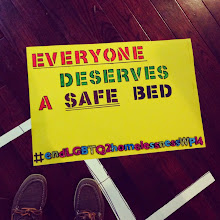
It is time to acknowledge that LGBTQ youth homelessness is a major issue in Toronto and that Toronto desperately needs to implement support services for our youth. Everyone deserves a safe bed, regardless of their gender or sexual identity.
Looking forward to celebrating love and authenticity this weekend.
Wishing everyone a happy and safe pride!
Friday, April 20, 2012
Research stories
I am currently in the data analysis and interpretation phase of my study.
Over the past year I have been busy conducting focus groups, one-on-one interviews, and observing shelter training workshops. I have spoken to LGBTQ homeless and street-involved youth, frontline shelter staff, Executive Directors,
City of Toronto shelter management, and workshop facilitators.
My plan was originally to share this process with you all, but I have been too busy to blog about it.
So, I've decided to start sharing snippets of my research story.
March 2011 - Approximately one year ago on my way to a youth shelter North of Toronto.
Sitting on the Greyhound bus departing from Toronto,
we drive through the city where homelessness is a very visible issue.
I see people sleeping on the streets on this freezing cold morning.
I drift in and out of sleep as we drive further from the city and closer to the country.
I wake to fields and trees, clearly we are out of the city.
I cannot help but notice how ironic it is that I am going so far from the city to research this problem that is a crisis in our city. But, here homelessness is a problem too. Perhaps not as visible as in Toronto.
The Executive Director picks me up from the station and together we drive to the youth shelter - a pretty yellow house.
The outside looks so welcoming, but that may not be the case for all youth, especially LGBTQ youth.
LGBTQ youth frequently migrate to Toronto for this reason.
However, sadly there is little support available in the form of specialized overnight services for this population of youth in Toronto as well.
I. Alex Abramovich
Friday, March 23, 2012
LGBTQ youth homelessness and the art of digital storytelling

I just spent three fabulous days in Ottawa at the Rainbow Health Ontario conference.
It was wonderful to see so many informative and groundbreaking presentations.
I feel very honoured to be part of this community and to have had the opportunity to speak to the issues of LGBTQ youth homelessness, because this population of youth is often left out of these important conversations.
The main goals of my presentation were to increase knowledge and awareness around LGBTQ youth homelessness in Canada, as well as to help formulate an understanding of the use of digital storytelling with LGBTQ youth and to have people leave with some key points of how digital storytelling is done.
I spoke about how we have extensive research on youth homelessness in Canada and within those studies it is often indicated that LGBTQ youth homelessness is on the rise, but agencies report difficulty in providing support, however there is seldom any follow-up or further investigation. Therefore, we have a large gap in knowledge in this area.
What we do know, however, is that queer youth are overrepresented in the homeless youth population and that approximately 25-40% of homeless youth identify as LGBTQ. We also know that a large proportion of youth migrate to Toronto hoping to find support services and safety because of Toronto’s queer friendly reputation and because Toronto is known as the homeless capital of Canada.
A high percentage of people who are homeless happen to be LGBT because they got kicked out of their
house, or maybe they lost their job, or they lived in a small town, then they can’t pay their rent and where else
can they come, but Toronto? (Homeless youth, 27 years old)
I also spoke about the risks encountered on the streets and in the shelter system, the daily challenges, and needs of queer homeless youth. Two films were screened to share the voices and stories of queer youth with lived experiences of homelessness.
I was extremely pleased to have such a full room of interested and engaged people to present to.
The questions and conversations that followed my presentation truly portrayed a group of people who want to see more support for LGBTQ homeless youth.
We must continue raising awareness to these issues.
We must continue sharing these important stories.
We must continue doing this until the appropriate support is in place.
Thank you,
I. Alex Abramovich
Tuesday, March 20, 2012
RHO 2012 Conference

Join us at the Rainbow Health Ontario Conference, March 20-23, 2012 at the Ottawa Marriott Hotel.
The theme of this conference is: “Supporting LGBT Health Through Every Stage of Life.”
Over 50 presentations and workshops will address issues surrounding the health and wellness of LGBTQ communities in Ontario.
Delegates from the health care, social service, public policy and other helping professions will be exposed to opportunities to learn more about LGBT health concerns, explore innovative research being done in this area, as well as be provided with several opportunities to network with other professionals from the academic, health and government sectors.
Ten workshops will be dedicated exclusively to issues relating to youth, eight dedicated to seniors, and seven dedicated to parenting.
I will be presenting on LGBTQ youth homelessness in Toronto and the use of Digital Storytelling (two short films will be screened) on Friday March 23, 2012 at 11am.
Thanks!
Friday, October 21, 2011
We NEED to make it better

I am deeply affected by the recent suicide of 15-year-old Jaimie Hubley from Ottawa, ON. Jaimie faced ongoing homophobic bullying and was treated cruelly in his high school because he was gay. He was made fun of because he chose figure skating over hockey. He tried to start a Rainbow Club, but the other students tore down his posters.
How many youth will need to be murdered by homophobia before people start to change?
My work focuses on LGBTQ youth homelessness in Canada.
I devote my life work to LGBTQ youth and to making Toronto a safer, more accessible, and supportive city for LGBTQ homeless youth. I’m very aware that we still have a lot of work to do. We need to invest more money into programs for LGBTQ youth, especially LGBTQ youth who are homeless. We NEED to STOP the homophobia and transphobia that throws 25-40% of youth out of their homes. We NEED to STOP the homophobia and transphobia that then kicks the same youth out of the shelter system, and we NEED to STOP the homophobia and transphobia that makes them then fear their lives on the streets. WE NEED TO STOP THIS NOW.
It is not okay that youth experience homophobia and transphobia in their homes, in school, in the shelter system, on the streets. WAKE UP, Canada.
We keep talking about how it gets better. Well, it’s time now that WE MAKE IT BETTER. Too many young people are dying because of hate. We need to implement strategies that will lead to change. People need to be educated. Homophobic slurs are not okay, no matter how busy you are (as a teacher or frontline worker), you need to STOP these incidents from occurring every single time.
We all need to stop and think about Jamie’s death.
We need to reflect and think about how to become a more accepting society.
Let’s start with the basics and learn about love.
Let’s teach each other how to ACCEPT love and authenticity.
It seems so simple, doesn’t it? Yet, as a society we have failed on every level.
So, let us start anew, because I believe that it can get better. We just need to put our hearts into this.
-Alex ilona Abramovich
The Lesbian Gay Bi Trans Youth Line: 1-800-268-9688 askus@youthline.ca http://www.youthline.ca
Kids Help Phone: 1-800-668-6868
Subscribe to:
Posts (Atom)